
Have you ever read “How Personal Interest Questions Improve Report Quality” and still had no clear next step? A useful interpretation should separate real conditions, alternative paths, and one action that can be tested.
This article reframes “How Personal Interest Questions Improve Report Quality” as conditional guidance, real-world evidence, and a testable next step rather than a one-line answer.
Why a one-line reading is not enough
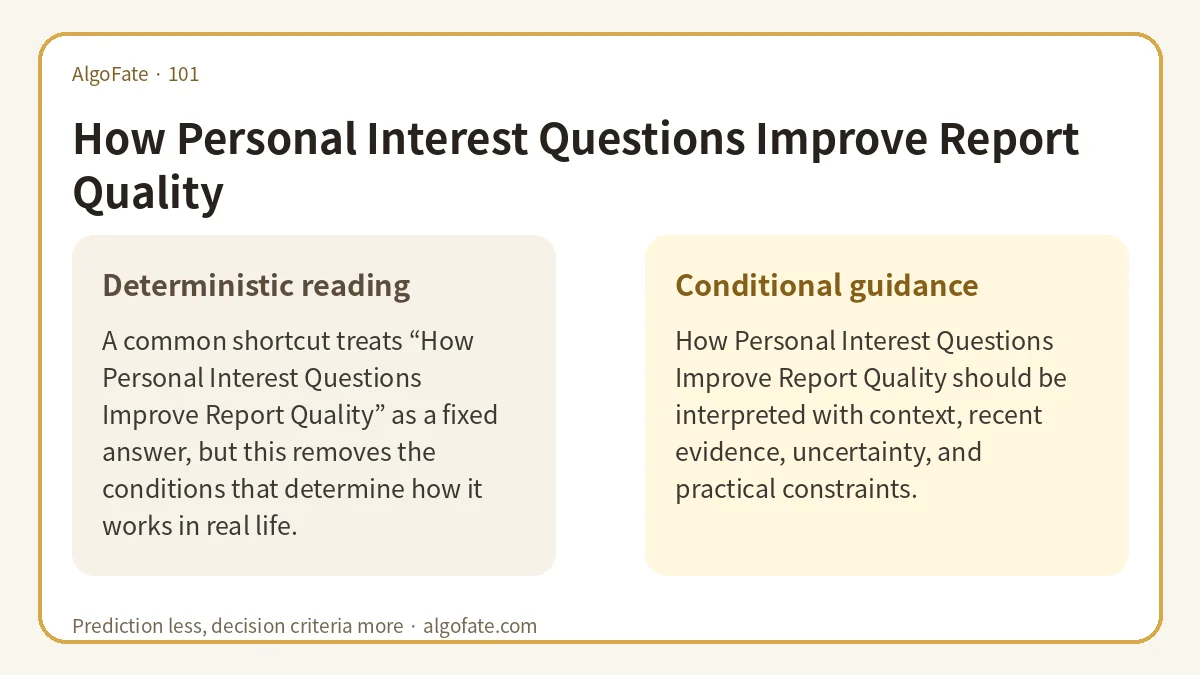
A common shortcut treats “How Personal Interest Questions Improve Report Quality” as a fixed answer, but this removes the conditions that determine how it works in real life.
Deterministic reading
How Personal Interest Questions Improve Report Quality gives one fixed answer.
Conditional guidance
How Personal Interest Questions Improve Report Quality becomes a decision-support framework for comparing conditions, costs, and reversible next steps.
What should be considered together?
How Personal Interest Questions Improve Report Quality should be interpreted with context, recent evidence, uncertainty, and practical constraints.
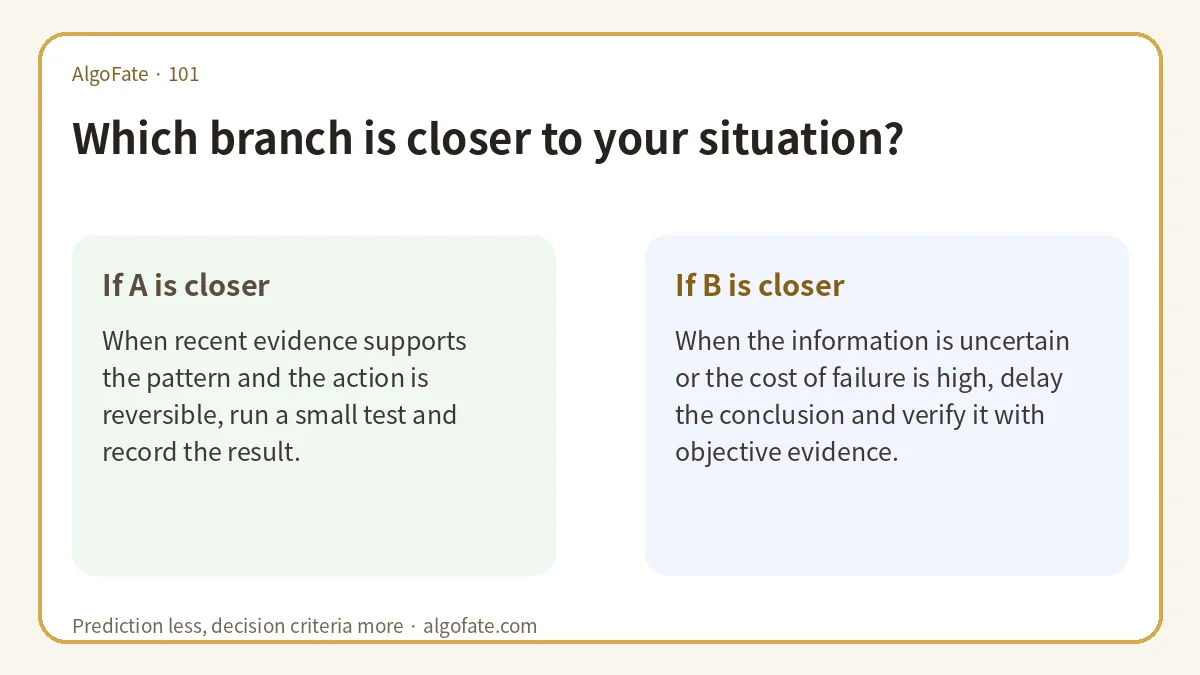
Which branch is closer to your situation?
If A is closer
When recent evidence supports the pattern and the action is reversible, run a small test and record the result.
If B is closer
When the information is uncertain or the cost of failure is high, delay the conclusion and verify it with objective evidence.
A real-life case
A reader in their thirties received a confident answer about how personal interest questions improve report quality, but the useful breakthrough came from identifying the condition that repeatedly caused the problem.
Practical checklist
- Write your current question in one sentence.
- List at least two recent situations.
- Separate facts, emotions, and interpretation.
- Compare branch A and branch B.
- Choose one small test and a stop rule.
- Set a review date.
Frequently asked questions
Can this article decide a major choice for me?
No. Use it to organize options and verify high-impact choices with objective records and qualified advice.
What if the reading conflicts with my experience?
Prioritize recent concrete evidence and recheck the input, assumptions, and counterexamples.
How long should I track the pattern?
One to two weeks may show a small behavior; recurring work, relationship, or money patterns usually need four weeks or more.
This article is general information for self-understanding and decision support. For medical, legal, financial, or investment decisions, use objective evidence and qualified professional advice.