Have you ever read “Eating God vs. Hurting Officer: Stable Production and Critical Improvement” and still wondered what you should actually do next? A useful reading should not stop at a label; it should separate conditions, alternatives, and a small action you can verify.
This article turns “Eating God vs. Hurting Officer: Stable Production and Critical Improvement” from a one-line definition into situational advice, branching criteria, and a testable next step.
Why the usual explanation is not enough
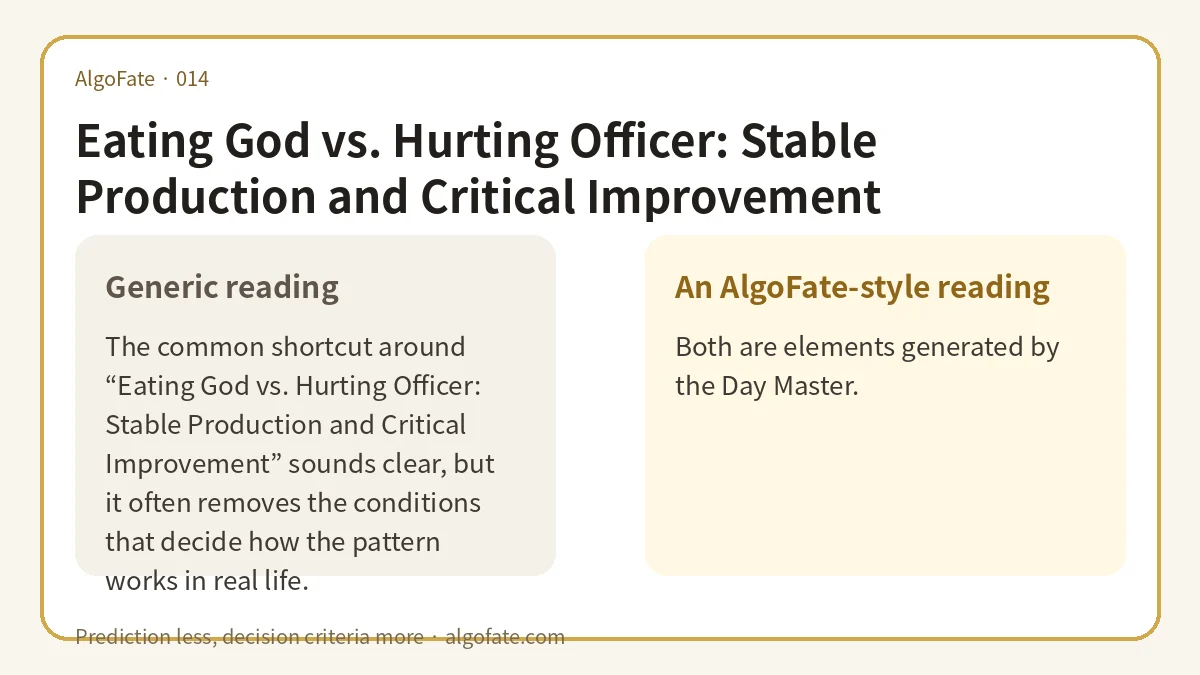
The common shortcut around “Eating God vs. Hurting Officer: Stable Production and Critical Improvement” sounds clear, but it often removes the conditions that decide how the pattern works in real life.
Generic reading
Eating God vs. Hurting Officer: Stable Production and Critical Improvement is a fixed label that tells whether a trait is good or bad.
An AlgoFate-style reading
Eating God vs. Hurting Officer: Stable Production and Critical Improvement is a working framework for identifying the conditions under which the same pattern becomes useful or costly.
The underlying principle: what must be read together?
Both are elements generated by the Day Master.
- The Day Master’s energy moves outward and becomes speech, action, technique, products, or deliverables.
- a QA analyst creating test cases
- a writer producing an article
Which branch is closer to your situation?
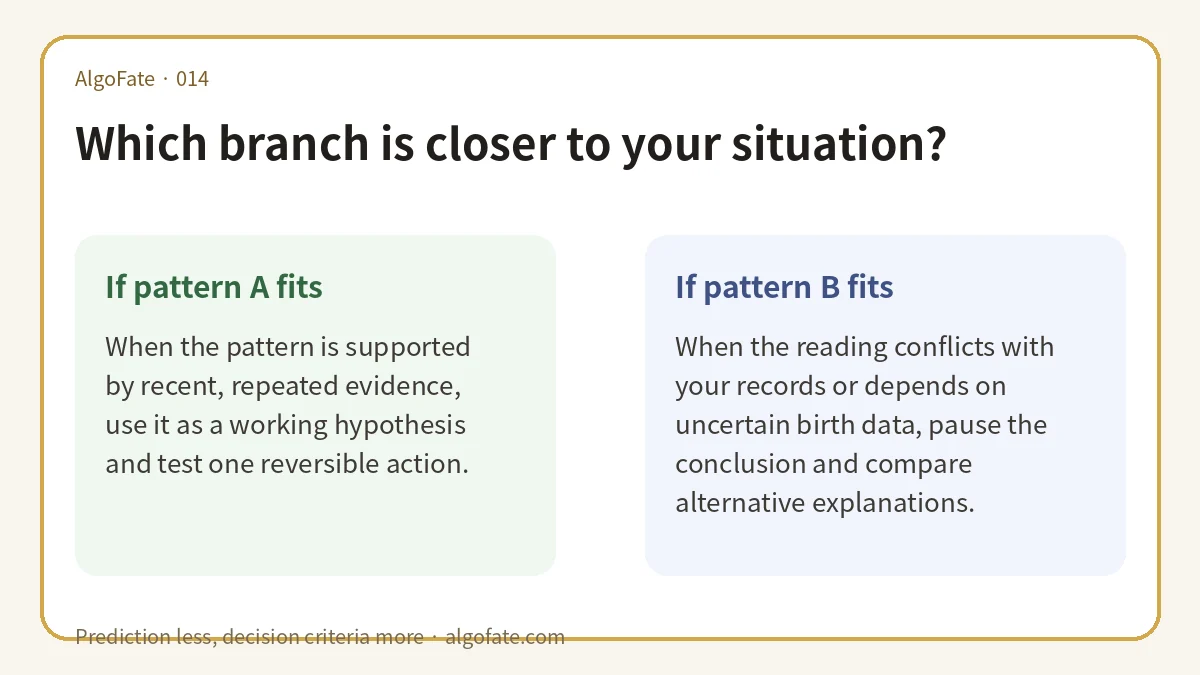
If pattern A fits
When the pattern is supported by recent, repeated evidence, use it as a working hypothesis and test one reversible action.
If pattern B fits
When the reading conflicts with your records or depends on uncertain birth data, pause the conclusion and compare alternative explanations.
A real-life case: what a one-line reading missed
A reader in their thirties received a confident one-line answer about eating god vs. hurting officer: stable production and critical improvement. After reviewing actual events, the useful issue was not the label itself but the condition that repeatedly triggered overload.
A practical checklist
- Verify birth data and calculation rules.
- Write down at least two recent concrete situations.
- Separate facts from interpretation.
- Compare the conditions for branch A and branch B.
- Choose one small reversible action.
- Set a stop rule and a review date.
Frequently asked questions
Can I make a major decision from this interpretation alone?
No. Use it to organize options, then verify high-impact decisions with records, contracts, health information, and qualified advice.
What if the interpretation does not match my experience?
Prioritize concrete recent evidence. Recheck the input, scope, and counterexamples, and discard a reading that is not useful.
How long should I observe the pattern?
One to two weeks may be enough for a small behavior; recurring work or relationship patterns usually need four weeks or more.
This article is general information for self-understanding and decision support. For medical, legal, financial, or investment decisions, use objective evidence and qualified professional advice.